
Use ™ when your unregistered mark identifies goods. Use ℠ when it identifies services. Use ® only after the USPTO has granted federal registration. That’s the whole rule; everything below explains why it matters and how to apply it correctly.
Here’s the quick-reference version:
- ASTRO™ — a physical product (athletic gear, packaged goods, hardware) using an unregistered mark
- JETSET℠ — a concierge or travel service using an unregistered mark
- BRIGHT® — a mark that has received USPTO federal registration for its listed goods or services
- Both ™ and ℠ are notice devices. They signal a claim of rights under common law without requiring any registration.
- ® is a statutory marker. Using it before the USPTO issues registration is unlawful and can create real legal exposure.
If you sell a physical product, start with ™. If you provide a service, ℠ is technically correct, though many U.S. businesses use ™ for simplicity. If you’ve registered, switch to ®.
Table of Contents
- What do TM and SM actually do under U.S. law?
- When should you use TM vs SM? Real examples
- How to place and format ™, ℠, and ® across channels
- What does ® mean and how do you get federal registration?
- Common pitfalls and how to avoid them
- How to type ™, ℠, and ® on any device
- Key Takeaways
- The case for keeping it simple — and precise when it counts
- Copyrighttoolkit makes symbol insertion instant
- Authoritative sources and further reading
What do TM and SM actually do under U.S. law?
Neither ™ nor ℠ creates a federal registration. That’s the most important thing to understand up front. Both symbols are notice devices, meaning they tell the public you’re claiming trademark rights in a word, logo, slogan, or design. Your actual rights come from use, not from the symbol itself.
Under the Lanham Act, trademarks and service marks receive identical legal treatment. The distinction between them is purely categorical: goods versus services. The registration process, examination standards, filing fees, and enforcement remedies are the same for both. A ™ on a product and a ℠ on a service carry the same legal weight as notice devices.

Common-law rights arise from use in commerce. If you’ve been using ASTRO™ on athletic gear in your region for two years, you have common-law priority in that geographic area, even without a federal registration. Those rights are real but limited. They don’t extend beyond the territory where you’ve actually used the mark, and they don’t come with the presumptions and remedies that federal registration provides.
The ® symbol is different in kind, not just degree. Using ® on an unregistered mark is prohibited under U.S. law. It can affect your ability to recover certain remedies in litigation and may be used against you in opposition or cancellation proceedings. The rule is simple: ® only after the USPTO issues the certificate.
Key legal point: The Lanham Act (15 U.S.C. § 1127) defines a service mark as “a mark used in the sale or advertising of services to identify and distinguish the services of one person from the services of others.” Trademarks and service marks are treated identically under federal law — the category of use (goods vs. services) is the only meaningful distinction.
When should you use TM vs SM? Real examples
The goods-versus-services line is usually clear, but hybrid businesses make it messier. Here are four scenarios that cover most situations creators and small business owners actually face.
Freelance designer (services only)
You design logos and brand identities for clients. Your studio name is INKFRAME. Since you’re selling a service, ℠ is technically precise: INKFRAME℠. That said, INTA notes that ™ is widely recognized internationally and frequently used for services without legal penalty. If you work with international clients or just want one consistent symbol, INKFRAME™ works fine.

Handcrafted goods seller (goods only)
You sell hand-thrown ceramic mugs under the brand CLAYMADE. That’s a physical product, so ™ is the right call: CLAYMADE™. Use it on your product tags, packaging, Etsy shop header, and any press materials. No ambiguity here.
SaaS app with physical merchandise (hybrid)
Your software platform is called LOOPBASE. You also sell branded hoodies and notebooks in your online store. A single brand can function as both a trademark and a service mark — the USPTO treats “trademark” as an umbrella term. In practice, most hybrid businesses use ™ across all consumer-facing channels for consistency. If you want precision, use ™ on product SKUs and ℠ on service descriptions in legal documents or your terms of service.

Streaming platform (services)
You run a subscription video platform called WAVEPATH. It’s a service, so ℠ is accurate. But given that ™ is the globally recognized default and your audience is international, WAVEPATH™ on your homepage and social profiles is a reasonable, legally acceptable choice.
The short version: when in doubt about goods versus services, ™ is the pragmatic default. ℠ earns its place in service-specific legal documents and in industries where the distinction matters to your audience or counsel.
How to place and format ™, ℠, and ® across channels
Placement is more flexible than most people assume. There is no strict federal requirement for symbol position, font size, or exact formatting. The standard convention — superscript to the upper-right of the mark — is common because it’s readable and unambiguous, but it isn’t legally mandated. Consistency across your channels matters more than pixel-perfect placement.
Here’s how to apply that across the places your brand actually appears:
- Website: Mark the first or most prominent occurrence of your brand name on each page. The header or hero section is the natural place. You don’t need to mark every single instance throughout the body copy.
- Packaging and product labels: Place the symbol adjacent to the brand name on the primary display panel. Repeat it on secondary panels if the brand name appears there prominently.
- Social media profiles: Include the symbol in your bio or display name on the first use. On platforms that strip special characters, use the plain-text equivalent ™ in parentheses as a fallback.
- PDFs and contracts: Mark the first mention of the brand name. A footnote defining the mark and its owner is standard practice in formal documents.
- Press releases and marketing materials: First mention only. Subsequent uses in the same document don’t need the symbol.
- UI strings and app interfaces: Mark the brand name in the app’s “About” screen or terms of service. Avoid cluttering every button or label.
Pro Tip: When your brand appears across both goods and services channels, pick one symbol and use it everywhere consumer-facing. Most U.S. businesses default to ™ for this reason. Reserve ℠ for service-specific legal documents where the distinction genuinely matters.
What does ® mean and how do you get federal registration?
The ® symbol signals that the USPTO has issued a federal registration for the specific goods or services listed in your application. It’s not just a stronger version of ™. It’s a different legal status entirely, one that comes with nationwide constructive notice, a presumption of ownership, and access to federal courts and certain statutory remedies.
Federal registration strengthens enforcement rights in ways that common-law use simply can’t match. You can bring suit in federal court, seek statutory damages, and use the registration as a basis for blocking infringing imports through U.S. Customs. For any brand planning to scale nationally, registration is worth the investment.
The basic path to registration follows these steps:
- Clearance search. Search the USPTO’s TESS database and common-law sources to check for conflicting marks before you file. Skipping this step is the most expensive mistake applicants make.
- File your application. Choose a filing basis: use-in-commerce (if you’re already using the mark) or intent-to-use (if you plan to use it). The USPTO explains both bases in its online guidance.
- USPTO examination. An examining attorney reviews the application, typically within several months of filing. They may issue an office action requesting clarification or raising refusals.
- Publication for opposition. If the examiner approves the mark, it’s published in the Official Gazette. Third parties have 30 days to oppose.
- Registration or notice of allowance. For use-in-commerce applications, the certificate issues after the opposition period closes. For intent-to-use applications, you’ll receive a notice of allowance and must submit a statement of use before registration issues.
On cost: USPTO filing fees depend on the application type and number of classes. The USPTO’s current fee schedule is posted at USPTO.gov. Attorney fees vary widely; many trademark attorneys offer flat-fee filing packages for straightforward applications. DIY filing is possible but carries real risk if your identification of goods and services is imprecise.
You can use ™ or ℠ while your application is pending. Switch to ® the day your registration certificate arrives, not before.
Common pitfalls and how to avoid them
Most trademark problems are self-inflicted. The mistakes below are the ones that show up repeatedly in office actions, oppositions, and infringement disputes.
- Using ® before registration. This is the clearest line in trademark law. Don’t cross it. Even if your application is pending, ® is off-limits until the certificate issues.
- Marking the wrong goods or services. If your registration covers “clothing” but you’re using ® on a software product, that’s a misuse. Incorrect markings can lead to cancellation or weaken your position in disputes.
- Inconsistent marking. Using your brand name sometimes with ™ and sometimes without signals to examiners and courts that you’re not treating it as a mark. Pick a symbol and use it consistently.
- Assuming ™ or ℠ grants the same remedies as ®. Common-law rights are real but geographically limited. They don’t give you access to federal courts or statutory damages. They also don’t create the nationwide presumption of ownership that registration does.
- No first-use records. Your common-law priority depends on proving when you first used the mark in commerce. Keep dated records: invoices, screenshots, advertising materials, shipping receipts. If a dispute arises, these are your evidence.
Pro Tip: Before you launch a brand commercially, run a basic clearance search on the USPTO’s TESS database. It takes 20 minutes and can save you from building equity in a mark you’ll have to abandon later.
For enforcement, the path depends on your registration status. With only common-law rights, you’re limited to state court and geographic scope. With a federal registration, you can send a cease-and-desist letter backed by a registration number, file in federal court, and pursue statutory remedies. Either way, document your use thoroughly and work with a trademark attorney before sending any formal demand.
How to type ™, ℠, and ® on any device
Getting the symbols right technically is as important as knowing when to use them. Here’s everything you need.
Unicode, HTML, and code reference
| Symbol | Name | Unicode | HTML Entity | HTML Decimal |
|---|---|---|---|---|
| ™ | Trade Mark Sign | ™ | ™ |
™ |
| ℠ | Service Mark | ℠ | ℠ | ℠ |
| ® | Registered Sign | ® | ® |
® |
These Unicode code points render correctly in all modern browsers and operating systems. Use the HTML entity form in web copy and the Unicode character directly in word processors, design tools, and social platforms.
Keyboard shortcuts by platform
Windows:
- ™ — Alt + 0153 (numeric keypad)
- ® — Alt + 0174 (numeric keypad)
- ℠ — No standard Alt code; use the Unicode character map (Win + R → charmap) or copy-paste
macOS:
- ™ — Option + 2
- ® — Option + R
- ℠ — No default shortcut; use Edit → Emoji & Symbols, search “service mark”
Mobile (iOS and Android):
- Long-press the TM or R key on most keyboards to reveal ™ and ® as pop-up options
- For ℠, use your device’s character picker or copy it from a reference source
Best practices for digital accessibility
- When using trademark symbols in HTML, add
aria-labelattributes to icon-only uses so screen readers announce the mark correctly. - For logos displayed as images, include the symbol in the
alttext (e.g.,alt="ASTRO trademark logo"). - In plain-text environments (email subject lines, CSV exports), use the parenthetical form: ™, (SM), or ®.
Copyrighttoolkit’s symbol copy-paste tools let you grab ™, ℠, and ® instantly without memorizing Alt codes or digging through character maps.
Key Takeaways
TM and SM are notice devices for unregistered marks; ® is a statutory marker that requires a USPTO-issued federal registration and carries nationwide legal presumptions that common-law use cannot replicate.
| Point | Details |
|---|---|
| TM vs SM distinction | Use ™ for goods, ℠ for services — but ™ is legally acceptable for services in most U.S. contexts. |
| Both are unregistered notice devices | Neither ™ nor ℠ creates federal rights; common-law rights arise from actual use in commerce. |
| ® requires registration | Only use ® after the USPTO issues your registration certificate; misuse is unlawful. |
| Registration benefits | Federal registration adds nationwide presumption of ownership and access to stronger enforcement remedies. |
| Copyrighttoolkit symbol tools | Use Copyrighttoolkit’s copy-paste tools to insert ™, ℠, and ® correctly across web, packaging, and social channels. |
The case for keeping it simple — and precise when it counts
Most of the confusion around ™ versus ℠ comes from treating them as legally distinct when, under the Lanham Act, they’re functionally equivalent. The goods-versus-services line matters for classification purposes in a USPTO filing, but for day-to-day brand marking, the practical difference is small.
What actually matters is consistency and timing. A brand that marks its name reliably with ™ from day one, keeps dated records of first use, and files a federal application before scaling nationally is in a far stronger position than one that agonizes over ™ versus ℠ but marks inconsistently or skips the clearance search.
The conventional advice to “always use ℠ for services” is technically correct but misses the point for most small businesses. INTA explicitly notes that ™ is the internationally recognized standard and that ℠ is more U.S.-centric. If your business has any international dimension, or if you simply want one symbol across all channels, ™ is the cleaner choice.
Where precision genuinely matters is in legal documents, USPTO filings, and formal licensing agreements. In those contexts, matching your symbol to your goods-versus-services classification reduces friction with examiners and leaves no ambiguity in contracts. Outside those contexts, pick ™, use it consistently, and focus your energy on the clearance search and the registration filing.
Copyrighttoolkit makes symbol insertion instant
Getting the right symbol into the right place shouldn’t slow you down. Copyrighttoolkit gives you instant copy-paste access to ™, ℠, and ®, along with their Unicode code points, HTML entities, and keyboard shortcuts for Windows, macOS, and mobile — all in one place.
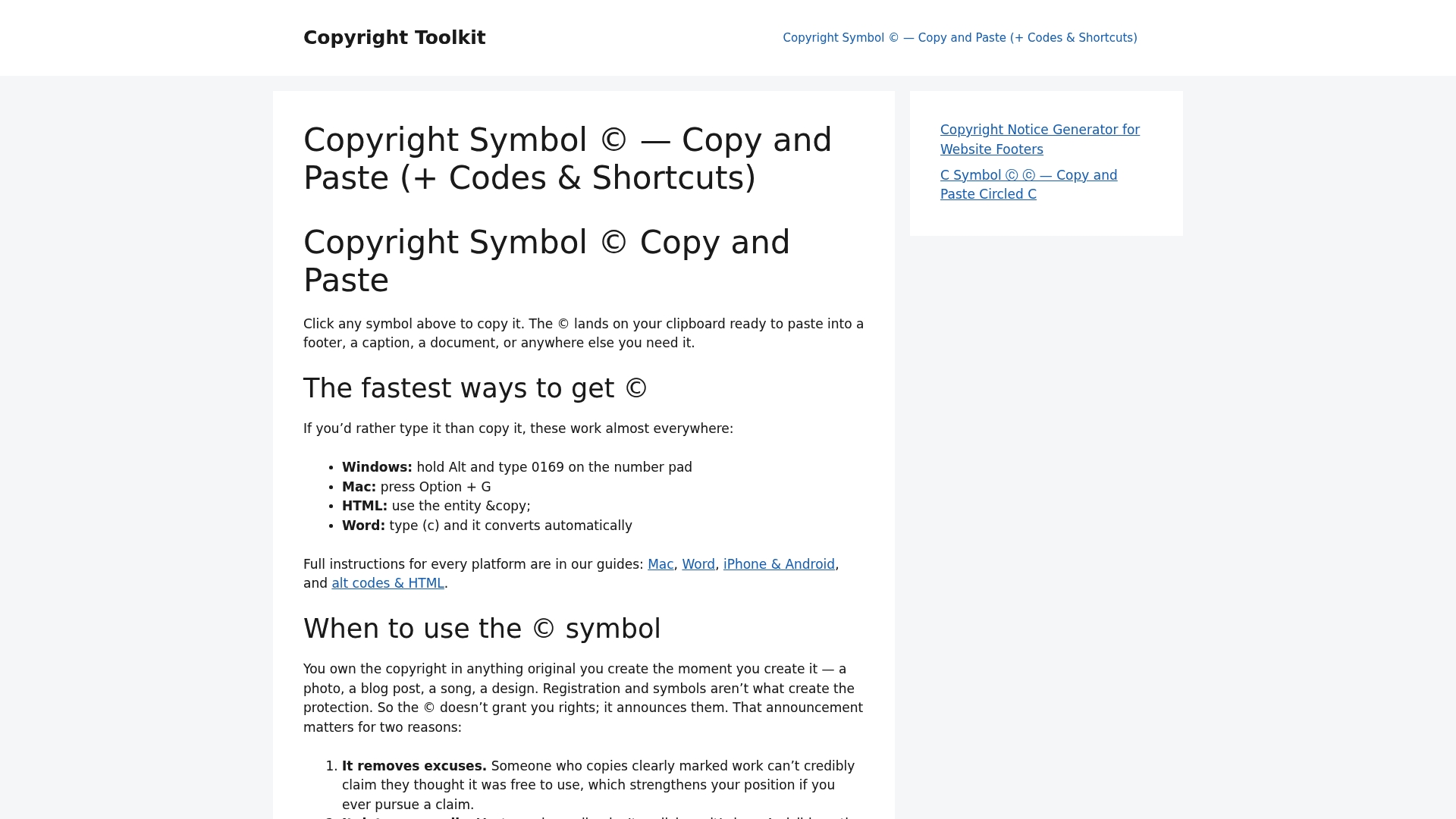
Whether you’re updating a product page, drafting a press release, or setting up your social bio, you can grab the correct symbol in seconds without hunting through character maps or memorizing Alt codes. The tools cover symbol insertion and formatting guidance; for registration steps and legal advice, the USPTO’s official resources and a qualified trademark attorney are your authoritative sources.
Head to Copyrighttoolkit to copy ™, ℠, or ® right now, then bookmark the page for every time you launch a new product, update your packaging, or file a new application.
This article is general information, not legal advice. Confirm current USPTO rules and fees at USPTO.gov, and consult a qualified trademark attorney for guidance specific to your situation.
Authoritative sources and further reading
- USPTO — What is a trademark? — The primary source for U.S. trademark and service mark definitions, symbol usage rules, and registration basics. Start here for official guidance on when ® is permitted.
- INTA — Trademark Symbols Fact Sheet — The International Trademark Association’s plain-language explanation of ™, ℠, and ® placement, formatting, and international usage conventions.
- Legal Information Institute — Service Mark (Wex) — Cornell Law’s concise definition of service marks under the Lanham Act, with statutory citations.
- USPTO Trademark Manual of Examining Procedure (TMEP) — The examiner’s handbook; useful for understanding how the USPTO evaluates applications and what triggers office actions.
- Copyrighttoolkit — Symbol copy-paste tools — Instant copy-paste for ™, ℠, ®, and related symbols, plus Unicode, HTML, and keyboard shortcut references for all major platforms.