Copyright term length in the United States runs for the life of the author plus 70 years for anything created on or after January 1, 1978. Anonymous and pseudonymous works, along with works made for hire, get a flat 95 years from publication or 120 years from creation, whichever comes first. Works published before 1978 follow a completely different two-term system rooted in the old 1909 Act, and plenty of them have already fallen into the public domain.
TL;DR:
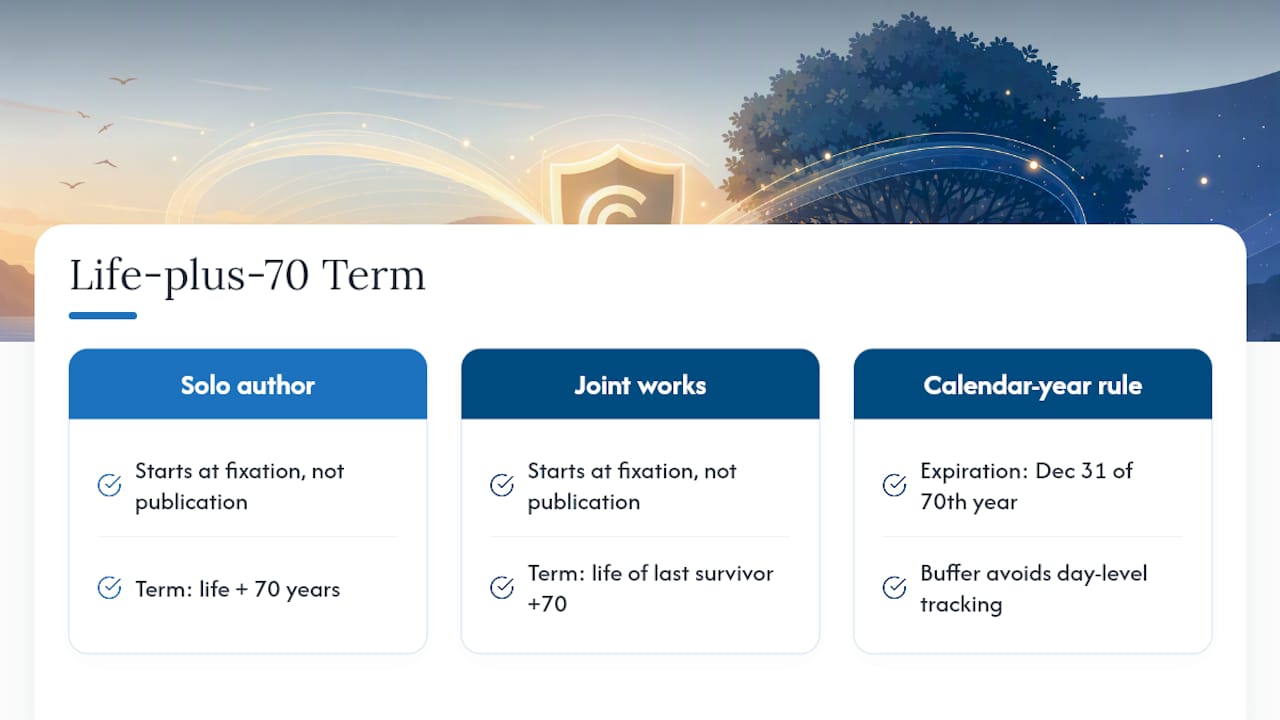
- Works created on or after 1978 by an individual author are protected for the life of the author plus 70 years, with joint works extending to the last surviving co-author’s death plus 70 years.
- Works made for hire, anonymous, or pseudonymous works after 1978 are protected for 95 years from publication or 120 years from creation, whichever ends first.
- Pre-1978 works generally fall into a system with initial 28-year protection and potential renewal, but many have already entered the public domain due to missed filings or expiration.
- For works from 1931 to 1963, checking renewal records is essential, as many were lost to lapse due to missed registration deadlines.
- International copyright terms vary; some countries adhere to life plus 50 years, so foreign works might be public domain elsewhere well before U.S. expiration.
Table of Contents
- U.S. copyright rules at a glance
- Works created on or after January 1, 1978: life of the author plus 70 years
- Works first published or created before 1978: renewal and legacy terms
- Special cases: anonymous, pseudonymous, works made for hire, and sound recordings
- How to compute a copyright expiration date step by step
- How to check copyright status using primary sources
- International differences and public-domain thresholds
- Practical steps for creators: marking, registering, and preserving proof
- Why copyright term length matters more than most creators realize
- Tools to help you mark and document your work correctly
- Where to go for authoritative answers
- Sources
U.S. copyright rules at a glance
Before getting into the statutory weeds, it helps to know which bucket your work falls into. The rule that applies depends almost entirely on two things: when the work was created or published, and who (or what) is legally considered the author.
Here’s the quick map most people need:
- Created on/after January 1, 1978, with a known individual author: life of the author plus 70 years.
- Joint work with multiple known authors, created on/after 1978: life of the last surviving author plus 70 years.
- Anonymous or pseudonymous work, or work made for hire (any date after 1977): 95 years from first publication, or 120 years from creation, whichever comes first.
- Published before 1978, properly renewed: generally 95 years from the original publication date.
- Published before 1978, never renewed: almost certainly public domain now.
- Published before 1931: public domain under current U.S. rules, no exceptions.
Two dates matter more than any others: the date of creation and the date of first publication. For anything governed by the life-plus-70 rule, publication date is mostly irrelevant. For the fixed-term categories, publication date (or creation date if unpublished) is everything.
One more detail trips people up constantly: copyright terms don’t expire on the exact anniversary of death or publication. They run through December 31 of the year in which the term would otherwise end. A copyright that would technically expire on March 4 doesn’t die that day. It survives until midnight on December 31 of that same year.
Works created on or after January 1, 1978: life of the author plus 70 years
This is the rule that governs the overwhelming majority of copyrighted material in circulation today, and it comes straight from 17 U.S.C. § 302(a). The statute states that copyright in a work created on or after the 1978 effective date “subsists from its creation” and, for works with an identified individual author, “endures for a term consisting of the life of the author and 70 years after the author’s death.”
Notice what the statute doesn’t say. It doesn’t say the clock starts at publication. It doesn’t say the term depends on registration. Copyright protection attaches the moment a work is fixed in a tangible form, whether that’s a finished novel, a scribbled song lyric, or a photo saved to a hard drive. The life-plus-70 clock starts running at that instant of creation and simply keeps running for 70 years past the author’s death, regardless of whether the work was ever published, registered, or even shown to another person.
Joint works change the math slightly. Section 302(b) covers works “prepared by two or more authors” who did not work for hire, and the rule shifts to measuring from whichever co-author dies last. If three songwriters collaborate on a track and one dies in 2030, another in 2045, and the last in 2060, the copyright doesn’t expire until 2130, 70 years after the final surviving author’s death. This is why band credits and co-writing agreements matter for estate planning purposes far beyond royalty splits.
The term consists of the life of the author and 70 years after the author’s death, and for joint works, this period runs from the death of the last surviving author. That single clause in the statute is why a duo’s shared composition can stay protected for decades longer than either songwriter’s solo material written the same year.
The calendar-year rule from Circular 15A applies here too. Say an author dies on June 15, 2026. Add 70 years and you land on June 15, 2096. But the actual expiration date isn’t June 15, 2096. It’s December 31, 2096, because the term runs through the end of the calendar year in which the 70-year period would otherwise conclude. That six-and-a-half-month buffer exists purely so publishers, courts, and the Copyright Office don’t have to track exact death dates down to the day for expiration purposes.
There’s a practical wrinkle worth flagging for researchers and biographers: figuring out an author’s death date isn’t always straightforward, especially for lesser-known writers, illustrators, or photographers from the mid-20th century. LII’s annotated version of Section 302 addresses this directly through a presumption mechanism, which the next section on special cases covers in more detail. For now, the takeaway is simple: if you know the author’s identity and death date, life-plus-70 is a clean, calculable rule. The complications start when either piece of information is missing.
Works first published or created before 1978: renewal and legacy terms
Everything gets messier once you step before the 1978 cutoff, because you’re dealing with a completely different statutory framework: the Copyright Act of 1909. That law created a two-term system that no longer exists for new works but still governs the fate of millions of older ones.
Here’s how the old system worked and how later amendments changed it:
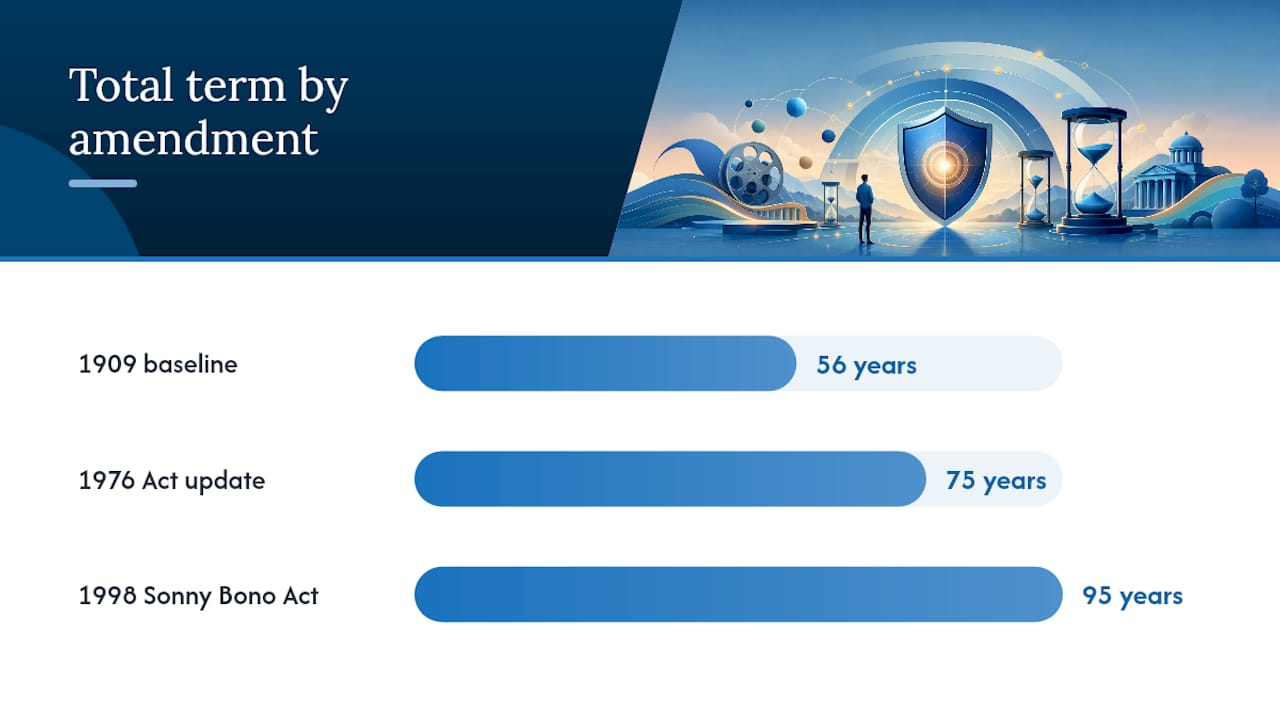
- Initial 28-year term. Under the 1909 Act, copyright began at publication (not creation) and lasted for an initial term of 28 years. Unpublished works generally weren’t protected under federal law at all until the 1976 Act changed that.
- Renewal requirement. At the end of the 28-year initial term, the copyright owner had to file a renewal registration with the Copyright Office to get a second term. Miss the deadline, and the work fell into the public domain immediately, no exceptions, no grace period.
- Original 28-year renewal term (1909 Act baseline). If renewed on time, the second term added another 28 years, for a maximum of 56 years total under the original law.
- 1976 Act extension to 47 years. The Copyright Act of 1976 extended that renewal term from 28 to 47 years for works still in their renewal period, pushing total protection to 75 years for many works.
- 1998 Sonny Bono Act extension to 67 years. The Copyright Term Extension Act of 1998 added another 20 years to the renewal term, bringing it to 67 years and stretching total protection to the 95-year figure that governs most surviving pre-1978 works today.
- Automatic renewal for 1964 to 1977 works. Congress eventually made renewal automatic for works first published between 1964 and 1977, closing off the most common way older works accidentally lost protection through missed paperwork.
The result of all these amendments stacking on top of each other is that a properly renewed work first published in, say, 1950 gets a full 95 years of protection, expiring at the end of 2045. A work from the same year that was never renewed has been in the public domain since 1979 and stayed there.
This is where research gets tedious but essential. If you’re trying to determine whether a specific pre-1964 work is protected, you need to check whether a renewal was actually filed, because failure to renew was extremely common and effectively dumped huge swaths of mid-century books, photographs, and films into the public domain. Cornell’s copyright term guide is one of the more usable starting points for this kind of research, laying out the publication-year cutoffs in plain language rather than statutory jargon.
The safest general marker: anything published in the U.S. before January 1, 1931, is public domain now, full stop, with no renewal question to chase down. Anything from 1931 through 1963 requires checking renewal records specifically, since those are the years where a missed renewal filing was fatal to the copyright and non-renewal was common enough to matter statistically.
Special cases: anonymous, pseudonymous, works made for hire, and sound recordings
Not every work has a neat, identifiable individual author whose lifespan you can track. Congress built a separate, fixed-term system into Section 302© for exactly these situations, and it applies to three distinct categories.
- Anonymous works where no author is identified in Copyright Office records at all.
- Pseudonymous works published under a pen name with the real identity undisclosed.
- Works made for hire, meaning works created by an employee within the scope of employment, or certain commissioned works falling into statutorily defined categories under a written work-for-hire agreement.
For all three, the term is 95 years from the year of first publication or 120 years from the year of creation, whichever expires first. This “whichever expires first” clause matters more than it looks. A work created in 2026 but never published would, under the 120-year branch, expire in 2146. But if that same work gets published in 2040, the 95-year clock kicks in from that publication date instead, and since 2040 plus 95 is 2135, which is earlier than 2146, the shorter 95-year path controls. The rule is designed to prevent unpublished works made for hire from sitting in limbo indefinitely.
There’s a built-in escape hatch for anonymous and pseudonymous works, though. If the true identity of the author gets recorded with the Copyright Office before the fixed term expires, whether through a registration record, a renewal filing, or another qualifying document, the work converts to the standard life-plus-70 calculation instead. This gives authors who initially published under a pen name a way to restore the longer, individually calculated term simply by stepping forward and putting their name on the record.
Sound recordings deserve a separate mention because they were governed by an entirely different legal regime for most of the 20th century. Recordings fixed before February 15, 1972, were largely protected under a patchwork of state laws rather than federal copyright law until the Music Modernization Act brought them under a unified federal framework with its own staggered public-domain transition schedule running from 2022 through 2067, depending on the recording’s original date. Recordings from 1972 onward follow the standard federal duration rules based on authorship type.
How to compute a copyright expiration date step by step
Working out an exact expiration date isn’t hard once you know which of four questions to ask, in order: Who is the author? Is authorship known or hidden? When was it created? When, if ever, was it published?
Pro Tip: Write down the applicable statutory path before you touch a calendar. Nine times out of ten, expiration-date mistakes come from applying the life-plus-70 formula to a work-for-hire piece, or vice versa, not from arithmetic errors.
Here’s how the math plays out across the scenarios you’re most likely to encounter:
That last row surprises a lot of people. Posthumous publication doesn’t restart or extend the clock under the life-plus-70 rule. The term is tied to the author’s death, not to when the work happened to see print.
When an author’s death date genuinely can’t be determined, Section 302(e) provides a presumption mechanism: after 95 years from first publication or 120 years from creation (whichever comes first), anyone relying in good faith on a Copyright Office certification that no death-date record exists is presumed to be acting on a work whose author died at least 70 years earlier. This is a safety valve for exactly the case where records are too thin to nail down an exact date.
How to check copyright status using primary sources
Guesswork about copyright status gets people into legal trouble more often than actual research does, and thankfully the primary sources for verification are free and public.
- Search the Copyright Office’s public catalog for registration and renewal records going back to 1978 electronically, with older records searchable through supplementary card catalogs.
- Request a certified search report directly from the Copyright Office when you need documentation that will hold up if your reliance on public-domain status is ever challenged.
- Consult Cornell’s public-domain guide for publication-year cutoffs and plain-language walkthroughs of the renewal-era rules.
- Cross-reference statutory text at LII when you need the actual legal language behind a rule rather than a summary of it.
- Document your search process (dates searched, records checked, conclusions drawn) so you have a defensible good-faith record if your public-domain determination is ever questioned later.
Database searches have real limits. The Copyright Office catalog is strongest for works registered or renewed after 1978, and gets thinner and less reliable the further back you go into the 1909 Act era, particularly for unregistered works or renewals filed under variant title spellings. When a search comes back inconclusive, that’s a signal to consult an intellectual property attorney rather than defaulting to an assumption in either direction. A wrong guess on either side of the public-domain line carries real consequences, either forgoing rights you actually hold or infringing on rights someone else still holds.
International differences and public-domain thresholds
Copyright term length outside the United States doesn’t always match American rules, and assuming otherwise is one of the most common mistakes creators make when reusing older foreign works.
- The Berne Convention sets a floor of life plus 50 years as the minimum term member countries must provide, though most developed nations now exceed that minimum.
- The European Union, the United Kingdom, and a large share of other Berne signatories have moved to life plus 70 years, mirroring the U.S. standard for individually authored works.
- Some countries still sit closer to the Berne floor of life plus 50 years, meaning a work could be public domain there years or decades before it clears U.S. copyright.
- Rules for anonymous works, government works, and works made for hire vary by country far more than the life-plus-70 baseline does, so don’t assume the U.S. 95/120-year fixed terms apply anywhere else.
- A work being public domain in its country of origin does not automatically make it public domain in the United States, and vice versa. Always check the specific country’s law before relying on any cross-border public-domain claim.
If you’re building a project that pulls from international sources, whether that’s translating a foreign public-domain novel or reusing archival photographs, check the specific term rule in that work’s country of origin rather than extrapolating from U.S. law. The gap between a 50-year and a 70-year minimum can mean a 20-year window where a work is free to use in one country and still fully protected in another.
Practical steps for creators: marking, registering, and preserving proof
Understanding how long protection lasts is only half the job. The other half is making sure you can prove your authorship and creation date if that protection is ever challenged.
- Use a proper copyright notice. The standard format is © followed by the year of first publication and the author’s name (© 2026 Jane Doe). Copyrighttoolkit’s circled-C symbol tool makes it fast to grab the correct symbol without hunting through keyboard shortcut menus.
- Embed metadata at creation. File metadata, timestamps, and version history all help establish a creation date if a dispute ever arises years later.
- Register with the Copyright Office when it matters most. Registration isn’t required for protection to exist, but it’s a prerequisite for filing an infringement lawsuit in federal court, and timely registration (generally within three months of publication) unlocks eligibility for statutory damages and attorney’s fees that unregistered works don’t get.
- Keep archival drafts. Save early drafts, source files, and correspondence that document the creative process. These become evidence of both authorship and creation date.
- Deposit copies with trusted repositories. A dated deposit copy, whether through Copyright Office registration or another verifiable archive, gives you a fixed reference point that’s hard to dispute later.
For anyone publishing a book specifically, a properly formatted copyright page does double duty: it’s a public notice and a piece of your own evidentiary record. Copyrighttoolkit’s book copyright page templates walk through the standard language publishers use, including how to phrase “all rights reserved” notices and edition statements correctly.
Why copyright term length matters more than most creators realize
The length of a copyright term is really a policy argument dressed up as a math problem: how long should an author’s exclusive control last before a work becomes shared cultural property? Life plus 70 years leans heavily toward incentivizing creation and rewarding an author’s heirs. Critics have long argued that a term running decades past an author’s death does little to encourage new creativity and mostly just delays public access, and there’s a legitimate case there. Once a work has been created, extending the term further doesn’t make the creator write more; it just postpones the moment the public gets free access.
Where I land, after working through the statutory history for this piece, is that the practical advice for creators shouldn’t depend on resolving that policy debate. Register your work when it counts, keep your proof of authorship organized, and don’t assume older material is fair game just because it feels old. The pre-1978 renewal mess is proof that copyright status often turns on a filing detail nobody thinks about until it’s too late. Treat your own paperwork with the same seriousness you’d want someone else’s estate to have shown, because eventually, your 70-year clock starts running too.
— Support
Tools to help you mark and document your work correctly
Getting the copyright term right is only useful if you also handle the marking and documentation side correctly, and that’s the exact gap Copyrighttoolkit fills. Instead of hunting through font menus or guessing at Unicode codes when you need a © symbol on a manuscript, a website footer, or a licensing agreement, Copyrighttoolkit gives you instant copy-paste access plus the keyboard shortcuts for Windows and Mac, so your notices go out formatted correctly the first time.
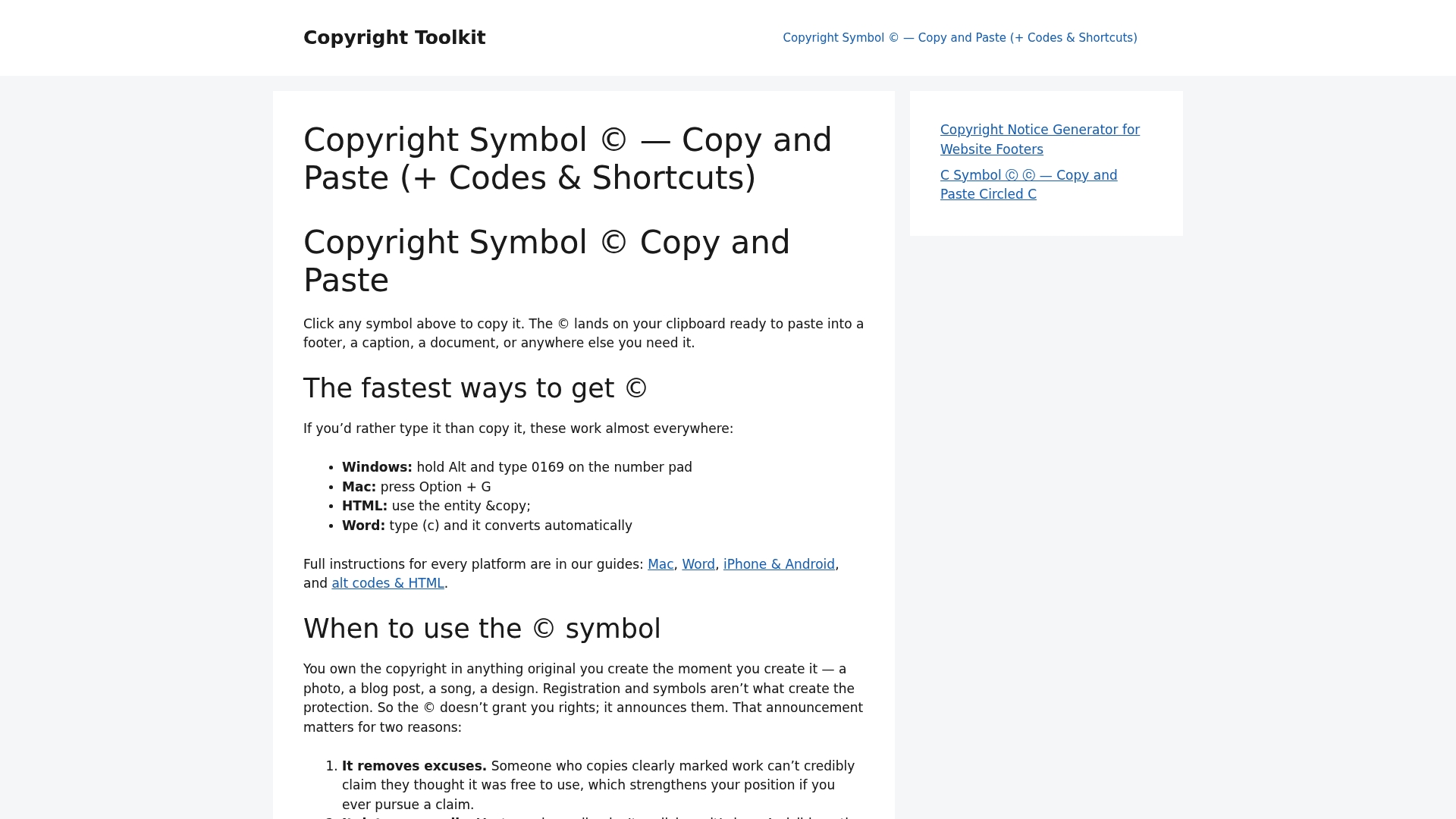
If you’re preparing a book for publication, the book copyright page templates give you sample language already aligned with standard U.S. notice conventions, so you’re not drafting legal boilerplate from scratch. Creators working with collaborators or AI-assisted content can also check the guidance on authorship and registration before filing anything with the Copyright Office. Start at Copyrighttoolkit to grab the symbol tools and templates you need before your next publication date.
Where to go for authoritative answers
Each of these sources handles a different piece of the copyright duration puzzle, and knowing which one to open first saves time.
For the actual statutory text, go straight to 17 U.S.C. § 302, the law that sets the life-plus-70 rule and the 95/120-year exceptions. For the official government explanation of how those rules apply in practice, including pre-1978 legacy terms and the calendar-year expiration rule, Circular 15A is the definitive document. If you just need a fast, plain-language answer, the Copyright Office’s own FAQ covers the basics in a few sentences.
For research help tracking down renewal records and public-domain cutoffs on older works, Cornell’s copyright guide is built specifically for that task. And for a plain-English legal explanation paired with the annotated statute, including the presumption rules for uncertain death dates, LII’s version of Section 302 is the strongest reference. Start with the FAQ for a quick answer, then move to Circular 15A or the statute itself once you need to compute an exact date.
This article is general information, not a substitute for advice from a qualified lawyer. Consult a qualified legal professional about your own circumstances before acting on anything here.
Sources
- Circular 15A: Duration of Copyright
- 17 USC 302: Duration of copyright: Works created on or after January 1, 1978
- How Long Does Copyright Protection Last? (FAQ) | U.S. Copyright Office
- Copyright term and the public domain | Cornell University Library
- 17 U.S.C. § 302 – Duration of copyright: Works created on or after January 1, 1978 | LII