
Copyright protects your software the moment you write it. No registration, no filing, no symbol required. But if you distribute that code, either as source or as a compiled binary, you should still add a clear copyright notice, an explicit license, and an AS IS disclaimer to every release.
Here’s why the notice still matters even though copyright exists automatically: it puts a fence around what’s already yours, tells anyone reading your code exactly who to credit or contact, and closes off the “I didn’t know it was protected” defense in a dispute. The minimum version takes about thirty seconds to write.
- Symbol or word: © or “Copyright”
- Year: the year of first publication, or a range if the code has evolved
- Owner: your name or your organization’s name
- License and disclaimer: state permissions explicitly, and add AS IS language to limit liability
- Machine-readable tags: SPDX identifiers so tooling can parse ownership and license automatically
Key Takeaways
A software copyright notice works best when it pairs three legal elements, symbol, year, owner, with an explicit license and an AS IS disclaimer placed everywhere the code travels.
| Point | Details |
|---|---|
| Use the three-element format | Combine © or “Copyright,” a publication year, and the owner’s name in every notice. |
| Pin the year, don’t chase it | Use first-publication year or a range, and let Git track later changes. |
| Notice needs a license | Ownership and permission are different things; always pair a notice with an explicit license. |
| Adopt SPDX tags | Use SPDX-FileCopyrightText and SPDX-License-Identifier for machine-readable, auditable headers. |
| Preserve third-party headers | Never edit or remove someone else’s copyright header when reusing their code. |
Table of Contents
- What Goes Into a Software Copyright Notice
- Where Should You Place a Copyright Notice?
- Why Pair the Notice With a License and Disclaimer?
- How Do You Write an SPDX-Compliant Header?
- How Do You Handle Third-Party Code and Contributions?
- Does Registering With the Copyright Office Matter?
- Where to Learn More
- What the Conventional Advice Gets Wrong
- Frequently Asked Questions
- Sources
What Goes Into a Software Copyright Notice
A valid notice has exactly three legal elements, and Nolo’s legal guidance lays them out plainly: the © symbol (or the spelled-out word “Copyright”), the year of publication, and the name of the copyright owner. Skip any one of the three and you’ve got something weaker than a real notice, even if it looks official.
- Choose the symbol or word. Either “©” or “Copyright” works; some developers use both for redundancy in plain-text files where the symbol might not render.
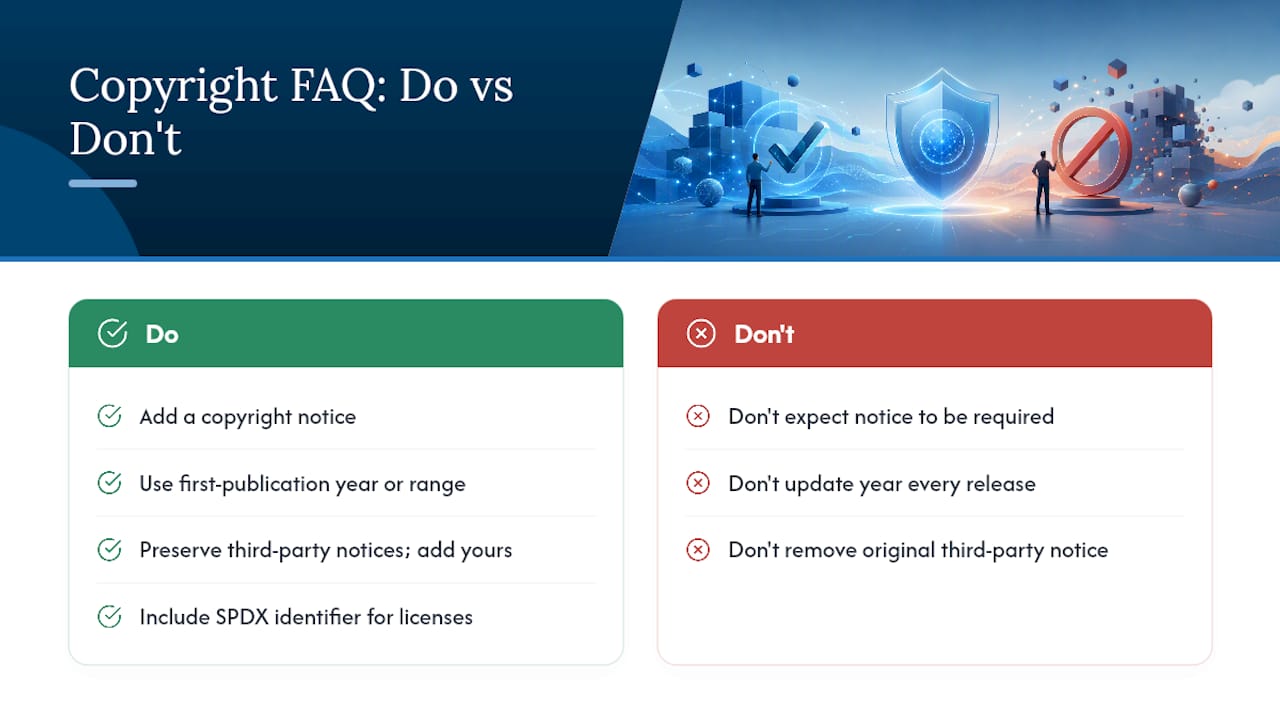
- Pick your year strategy. Use the year of first publication as a fixed anchor, or a range like 2020–2026 if the project has been actively maintained. Don’t rewrite the year with every commit. Your version control history already documents changes, and constantly updating the notice year just muddies the actual provenance of the work.
- Name the real owner. That’s you, your company, or whoever holds the rights under your employment or contributor agreement.
- Add optional fields when useful. A contact email or URL, an SPDX license identifier, or a short license tag all make the notice more useful without changing its legal weight.
Pro Tip: Don’t touch the copyright year every January. Pin it to first publication or a range, and let Git’s commit history do the job of tracking who changed what and when.
Where Should You Place a Copyright Notice?
Placement depends on how the software leaves your hands. A script that sits quietly on your own server needs less than a library you publish for other developers to fork.
- Source files: put a short header comment at the top of every file you distribute as source, not just the main entry point.
- Project root: add a LICENSE file for the full license text and a NOTICE file if you’re aggregating attributions from multiple contributors or dependencies.
- README: restate the copyright line and license name near the top, since that’s the first thing most people actually read.
- Binaries and UI: compiled software should surface the notice in an “About” screen, splash dialog, or
--versionoutput. - Packaging: installer scripts, package manifests (package.json, setup.py, pom.xml), and app store listings should carry the same ownership line as the code itself.
- SaaS and web apps: add a license or legal notice page, and if you offer downloadable exports or client libraries, bundle the notice with those artifacts too, since they leave your infrastructure even when the main app doesn’t.
UC Berkeley’s IPIRA office recommends exactly this spread for university-authored software distributed beyond campus: source, binary, README, and any public-facing footer.
Why Pair the Notice With a License and Disclaimer?
A copyright notice tells the world who owns the code. It does not tell anyone what they’re allowed to do with it. That’s the license’s job, and skipping it is the single most common mistake developers make when they think a notice alone is protection enough.
- State ownership with the notice. This establishes who holds the rights, full stop.
- Grant permissions with an explicit license. MIT, Apache 2.0, GPL, or a proprietary license you write yourself. Without one, anyone who wants to use your code legally has to guess, or ask, or walk away.
- Add AS IS disclaimer language. Something close to “This software is provided ‘as is,’ without warranty of any kind, express or implied.” UC Berkeley’s guidance recommends this exact pairing for any software an institution releases outside its own walls, precisely to limit liability when the software is used freely.
- Place the disclaimer where people will see it. The README, the license header of each file, and any web footer where the software is offered for download.
- Use an SPDX identifier instead of prose. Writing
SPDX-License-Identifier: MITremoves any ambiguity about which license variant applies, since license names alone (like “BSD”) can refer to multiple, subtly different texts.
A library guide on copyright versus licensing makes the distinction well: the notice is a signal of ownership, the license is the actual grant of permission, and conflating the two leaves real gaps in what users are legally allowed to do.
How Do You Write an SPDX-Compliant Header?
Modern open-source projects have largely moved past long prose disclaimers at the top of every file. The REUSE and SPDX approach compresses ownership and license into two machine-parseable lines that both humans and automated tools can read instantly.
- The core pattern:
SPDX-FileCopyrightText: 2026 Jane Developer <jane@example.com> SPDX-License-Identifier: MIT - C/C++:
// SPDX-FileCopyrightText: 2026 Jane Developer // SPDX-License-Identifier: Apache-2.0 - Java:
/* SPDX-FileCopyrightText: 2026 Jane Developer * SPDX-License-Identifier: Apache-2.0 */ - Python:
# SPDX-FileCopyrightText: 2026 Jane Developer # SPDX-License-Identifier: BSD-3-Clause - JavaScript:
// SPDX-FileCopyrightText: 2026 Jane Developer
// SPDX-License-Identifier: MIT
Tag every file this way and you can validate the whole repository automatically. Add a pre-commit hook that checks new files for the SPDX header before they’re committed, and wire a REUSE compliance check into your CI pipeline so a pull request without a valid header fails the build instead of slipping through.
Pro Tip: Run reuse lint against your repository before your first release. It flags every file missing a copyright or license tag in seconds, which beats discovering the gap during a legal audit.
How Do You Handle Third-Party Code and Contributions?
Never strip or overwrite a copyright header that came with someone else’s code. That header is a legal statement of ownership, and removing it can put you in breach of the original license even if your own intentions are harmless.
- Preserve third-party notices exactly as written, including formatting quirks, when you vendor in a dependency or copy a code snippet.
- Add your own copyright line only for the material you actually authored, placed clearly below or beside the original.
- Track every contributor in an AUTHORS or CONTRIBUTORS file, and roll up third-party attributions into a project-level NOTICE file so an auditor can see the full chain at a glance.
- When you copy a short snippet rather than a whole file, wrap it with
SPDX-SnippetBeginandSPDX-SnippetEndtags to keep the provenance visible without duplicating the entire original header.
Apache’s guidance on source headers treats this preservation rule as non-negotiable. Failing to keep original headers intact is one of the most common ways projects accidentally violate a license they never meant to break.
Does Registering With the Copyright Office Matter?
Registration isn’t required to hold copyright, but it changes what you can win in court. In the United States, registering before an infringement occurs (or within the statutory window after publication) opens the door to statutory damages and attorney’s fees, remedies that are often unavailable if you only register after the fact. The Copyright Office’s circular on registering websites and programs walks through deposit requirements for code and web-based work specifically.
A visible notice does separate work: it helps defeat an “innocent infringement” defense, since a defendant can’t credibly claim they didn’t realize the work was protected when your name and year are sitting right there in the header.
- If you receive an infringement notice: verify the license terms first, preserve your logs and commit history, and talk to counsel before responding.
- If you’re sending one: document the original notice and registration date before you act, since enforcement counsel will ask for exactly that evidence.
Where to Learn More
Start with the U.S. Copyright Office for registration basics, UC Berkeley’s IPIRA notice template for institutional wording, and the SPDX and REUSE writeup for header syntax. For copy-paste symbol formatting in your own files, Copyrighttoolkit’s circled C symbol guide covers the character options quickly.
What the Conventional Advice Gets Wrong
Most guidance on this topic treats the copyright notice like a legal incantation, something you paste once and forget. That’s backwards. The notice is the least interesting part of the whole system. What actually protects you is the combination of notice, explicit license, and disclaimer working together, validated automatically instead of policed by memory.
Developers who treat SPDX tagging as an afterthought are the ones who end up with license drift: half the files carry one license string, half carry another, and nobody notices until an acquisition due-diligence review or an open-source audit turns up the mismatch. A pre-commit hook that checks for SPDX-License-Identifier costs you ten minutes to set up. A license audit that fails during a funding round costs considerably more.
The other blind spot is the year field. Developers obsess over updating it annually as if that matters legally, while ignoring whether they’ve preserved third-party headers correctly in vendored dependencies. One of these mistakes is cosmetic. The other can put you in breach of someone else’s license. Prioritize accordingly.
Frequently Asked Questions
Do I legally need a copyright notice on my software?
No. Copyright protection is automatic once your code is written and fixed in a file. A notice isn’t mandatory, but it clarifies ownership and can help defeat a defendant’s claim of innocent infringement if you ever need to enforce your rights.
What’s the difference between a copyright statement and a software license?
A copyright statement declares who owns the work. A license grants specific permissions to use, modify, or redistribute it. You need both; a statement without a license leaves other developers guessing what they’re allowed to do with your code.
Should I update the copyright year every time I release a new version?
No. Use the year of first publication, or a range like 2020–2026, and let your version control system track the actual history of changes. Constantly updating the year adds noise without adding legal value.
What does SPDX-License-Identifier actually do?
It replaces a paragraph of license text with a single standardized string, like MIT or Apache-2.0, that both humans and automated compliance tools can parse instantly, removing ambiguity about exactly which license version applies.
Can I remove a third-party copyright notice if I rewrite most of the file?
No. Preserve the original notice and license header even if you’ve substantially modified the surrounding code. Add your own copyright line for the new portions instead of replacing the original attribution.
Sources
- What is copyright? | U.S. Copyright Office
- Placing a copyright notice on software | Nolo
- Software copyright notice and disclaimer | UC Berkeley IPIRA