Copyright infringement under U.S. federal law exposes you to civil damages within statutory ranges set by law per work and criminal penalties that can reach several years in prison for a first qualifying felony offense. The controlling statutes are 17 U.S.C. §504 (civil damages), 17 U.S.C. §505 (attorneys’ fees), 17 U.S.C. §506 (criminal offenses), and 18 U.S.C. §2319 (criminal sentencing). One detail that catches people off guard: whether you registered your work before the infringement began determines whether you can even access statutory damages and attorneys’ fees, under 17 U.S.C. §412.
At a glance:
- Civil statutory damages: a standard range per work; with higher maximums for willful infringement and lower minimums for innocent infringement
- Criminal exposure: Up to 5 years for a first qualifying felony; up to 10 years for subsequent felony offenses
- Governing statutes: 17 U.S.C. §504, §505, §506; 18 U.S.C. §2319
- Official guidance: U.S. Copyright Office and U.S. Department of Justice
- Registration timing: Under §412, registration before infringement (or within three months of first publication) is required to access statutory damages and attorneys’ fees
Key Takeaways
Civil copyright infringement penalties range from $750 to $150,000 per work under 17 U.S.C. §504, and criminal exposure under 18 U.S.C. §2319 can reach five years for a first qualifying felony, with registration timing under §412 determining access to the strongest civil remedies.
| Point | Details |
|---|---|
| Civil statutory range | Standard awards run $750–$30,000 per work; willful infringement can reach $150,000 per work. |
| Criminal felony threshold | Reproducing 10+ copies worth over $2,500 within 180 days triggers up to 5 years for a first offense. |
| Registration timing matters | Register before infringement or within three months of publication to preserve statutory damages and attorneys’ fees under §412. |
| Courts weigh willfulness | Willfulness, commercial scale, and repeat offenses are the strongest drivers of maximum awards. |
| Most cases settle | Cease-and-desist plus negotiated payment is the most common outcome; trial is the exception. |
Table of Contents
- 1. How civil copyright infringement penalties are calculated
- 2. When criminal law applies: fines, imprisonment, and prosecution thresholds
- 3. Other remedies courts can order beyond monetary damages
- 4. How courts decide the size of a damages award
- 5. What to do if you receive a copyright demand or face charges
- 6. Real-world outcomes: how statutory ranges translate to actual results
- A publisher’s note on why this matters
- Sources
1. How civil copyright infringement penalties are calculated
Civil liability under U.S. copyright law gives the copyright owner a choice between two fundamentally different recovery routes, and that choice can be worth hundreds of thousands of dollars depending on the facts.
The two routes: actual damages or statutory damages
The owner can elect either (1) actual damages plus the infringer’s profits, or (2) statutory damages per work infringed. That election can be made any time before final judgment, which creates a real tactical window. If the financial harm is hard to quantify, or if the infringer’s profits are modest, statutory damages often become the smarter play.
Under 17 U.S.C. §504, the statutory ranges work like this:
| Scenario | Statutory Damages Per Work | When It Applies |
|---|---|---|
| Standard infringement | a statutory range set by law | Default range; court has discretion within it |
| Willful infringement | a discretionary higher maximum | Plaintiff proves defendant knew or recklessly disregarded the copyright |
| Innocent infringement | a statutory lower minimum | Defendant proves no knowledge and no reason to know |

Courts have wide discretion within those ranges. A judge or jury can award $800 or $29,000 for the same act of copying, depending on the evidence of harm, the defendant’s conduct, and the number of works at issue. That uncertainty is exactly why statutory damages are such a powerful tool for plaintiffs when actual harm is hard to pin down.
How actual damages and profits work
When a plaintiff elects actual damages plus profits, the burden-of-proof split matters. The copyright owner proves the infringer’s gross revenue tied to the infringing activity. From there, the infringer must prove which expenses are deductible and which portion of profits is attributable to factors other than the infringement. That asymmetry tends to favor plaintiffs: showing gross revenue is usually easier than showing precise lost sales.
The innocent infringer defense
Courts may reduce statutory damages to as low as $200 per work when a defendant proves they had no knowledge and no reasonable basis to believe their acts constituted infringement. This is a rare outcome, but it can change exposure by orders of magnitude. A college student who reproduces an article believing it was in the public domain has a plausible innocent-infringer argument; a commercial distributor who ignores takedown notices does not.
Pro Tip: Register your work with the U.S. Copyright Office before infringement occurs, or within three months of first publication. Under 17 U.S.C. §412, failing to register in time locks you out of statutory damages and attorneys’ fees entirely, leaving you with only actual damages, which are often much harder to prove. See Copyrighttoolkit’s guide on book copyright pages and registration timing for a practical walkthrough.
2. When criminal law applies: fines, imprisonment, and prosecution thresholds
Civil liability is one thing. Criminal prosecution is another, and the line between them turns on specific statutory thresholds that most people don’t know exist.
The statutory framework: §506 and §2319
17 U.S.C. §506 defines criminal copyright infringement as willful infringement for commercial advantage or private financial gain, or willful reproduction or distribution of works meeting certain volume and value thresholds. 18 U.S.C. §2319 sets the actual sentencing ranges.
The threshold that converts conduct into a qualifying felony is specific: reproducing or distributing at least 10 copies of one or more copyrighted works with a total retail value exceeding $2,500 within any 180-day period. Hit those numbers, and a first offense can carry up to five years in federal prison. A second or subsequent qualifying felony offense can carry up to ten years.
Criminal penalty tiers
- Misdemeanor: Willful infringement not meeting felony thresholds; up to 1 year imprisonment
- First qualifying felony: 10+ copies, retail value over $2,500 within 180 days; up to 5 years
- Subsequent felony: Same conduct after a prior felony conviction; up to 10 years
- Sound recordings and motion pictures: Specialized provisions under §2319 address pre-release works and large-scale distribution with their own sentencing caps
- Fraudulent notice offenses: Under 17 U.S.C. §506, fraudulent placement or removal of copyright notices carries fines up to $2,500 per violation
What commonly triggers prosecution
- Commercial distribution of pirated physical goods (counterfeit DVDs, software)
- Organized uploading of copyrighted content for profit or large-scale free distribution
- Repeated infringement after cease-and-desist notices or prior civil judgments
- Pre-release distribution of motion pictures or sound recordings
A concrete example of how the 180-day test works
For example, redistributing multiple copies of a program within 180 days that exceed statutory quantity and retail value thresholds can qualify as a felony under criminal copyright law. Under 18 U.S.C. §2319, that conduct qualifies for felony prosecution with up to five years’ imprisonment, even if no money changed hands.
DOJ enforcement priorities
DOJ guidance makes clear that prosecutors weigh commerciality, scale, and evidence of willfulness when deciding whether to bring charges. Isolated personal copying rarely results in federal prosecution. Organized, repeat, or commercially motivated infringement is a different matter entirely. The analysis of piracy and enforcement trends suggests that aggressive enforcement can sometimes shift behavior in unexpected ways, which is part of why DOJ focuses resources on the highest-impact cases rather than individual downloaders.
3. Other remedies courts can order beyond monetary damages
Money isn’t the only thing on the table in a copyright infringement lawsuit. Courts have several additional tools, and some of them can be more immediately disruptive than a damages award.
Injunctions
A court can issue a temporary restraining order, a preliminary injunction, or a permanent injunction ordering the infringer to stop the infringing activity. Preliminary injunctions can arrive early in litigation, before any trial, which means an infringing product or service can be pulled from the market months before a final judgment. For a small business, that alone can be devastating.

Impounding and destruction
Under Chapter 5 of Title 17, courts may order the impounding of infringing copies and the equipment used to produce them. After a final judgment, the court can order destruction or other reasonable disposition of those materials. This goes beyond stopping future infringement: it eliminates existing inventory.
Attorneys’ fees and costs
17 U.S.C. §505 allows a prevailing party to recover full costs, including reasonable attorneys’ fees, at the court’s discretion. This cuts both ways: a prevailing plaintiff can recover legal costs, but so can a prevailing defendant. Courts consider factors like the frivolousness of the claim, the losing party’s motivation, and whether the litigation advanced important copyright principles.
Statute of limitations
Civil copyright claims must be filed within three years of the date the claim accrued. The clock typically starts when the copyright owner knew or reasonably should have known about the infringement. Miss that window and the claim is barred, regardless of how clear the infringement was.
Practical implications if you receive a demand letter or DMCA takedown
- Read the demand carefully and note every deadline stated in it
- Do not delete files, communications, or records related to the alleged infringement
- Check whether the work at issue is actually registered and when registration occurred
- Assess whether a fair use or other defense applies before responding
- Avoid making admissions in writing, even in informal emails
- Contact a copyright attorney before responding to any formal demand
A typical civil case timeline
Registration → cease-and-desist demand → complaint filed → motion for preliminary injunction → discovery (document production, depositions) → summary judgment or trial → final judgment and award.
4. How courts decide the size of a damages award
Statutory damages give courts wide discretion, and that discretion is not random. Judges and juries weigh specific aggravating and mitigating factors when setting an award within the statutory range.
Aggravating factors that push damages higher
- Willfulness: The defendant knew about the copyright and infringed anyway, or acted with reckless disregard
- Commercial purpose or private financial gain: Infringement for profit signals greater culpability
- Scale of distribution: More copies, wider reach, and longer duration all increase awards
- Repeat offenses: Prior infringement, especially after notice, is a strong aggravating signal
- Deception or fraud: Fraudulent removal or alteration of copyright management information under 17 U.S.C. §1202 can compound liability
Mitigating factors that push damages lower
- Good-faith fair-use belief: A defendant who genuinely believed the use was fair, with a reasonable basis for that belief, may receive a reduced award
- Innocent infringer status: Proven lack of knowledge and no reason to know (see §504’s $200 floor)
- Nonprofit or educational context: Courts may remit statutory damages entirely for qualifying nonprofit educational institutions, libraries, archives, or public broadcasters that reasonably believed the use was fair, under the language of §504©(2)
- Limited distribution: A single copy shared privately differs from mass distribution
- Prompt remedial action: Removing infringing content immediately upon notice can support a lower award
Common defenses
Burden allocation
For profits, the plaintiff shows gross revenue and the burden shifts to the defendant to prove deductible expenses and non-attributable factors. For willfulness, the plaintiff bears the burden of proof. For innocent infringement, the defendant must affirmatively prove lack of knowledge.
5. What to do if you receive a copyright demand or face charges
Getting a cease-and-desist letter or a formal complaint is stressful, but the first 48 hours matter more than most people realize. Here’s a clear sequence.
- Preserve everything. Do not delete files, emails, source code, or any record related to the work in question. Spoliation of evidence can independently harm your defense.
- Read the demand in full. Note the specific works claimed, the alleged acts, the statutory basis cited, and any deadlines for response.
- Check registration status. Determine whether the claimant’s work was registered before the alleged infringement or within three months of first publication. If not, statutory damages and attorneys’ fees are off the table for them, which changes the settlement calculus significantly.
- Assess fair use. Run through the four factors: purpose and character of use, nature of the copyrighted work, amount taken, and market effect. A strong fair-use argument can support a counter-notice or declaratory judgment action.
- Do not admit fault in writing. An informal email saying “sorry, I didn’t realize” can be used as an admission. Say nothing substantive until you have counsel.
- Contact a copyright attorney promptly. Even a single consultation can clarify your exposure, identify defenses, and help you decide whether to settle, fight, or counter-notify.
- Gather documentation. Collect your own registration records, creation timestamps, sales records, communications about the work, and any licenses you hold.
- Estimate your exposure. If the work is registered and willfulness is provable, the ceiling is $150,000 per work. If registration was late, the plaintiff is limited to actual damages, which may be far lower. That gap shapes every settlement negotiation.
Pro Tip: If you receive a DMCA takedown notice on a platform like YouTube or a web host, you have the right to file a counter-notification if you believe the takedown was improper. Counter-notifying restores your content after a waiting period unless the claimant files suit. But filing a counter-notice when the infringement is clear can accelerate litigation. Get legal advice before counter-notifying in any case where the underlying facts are genuinely disputed.
Defense costs in copyright cases can run from a few thousand dollars for a quick settlement to six figures for a contested trial. Some professional liability and media perils insurance policies cover copyright defense costs. Check your existing coverage before assuming you’re paying out of pocket.
6. Real-world outcomes: how statutory ranges translate to actual results
Statutory ranges tell you the ceiling and floor. They don’t tell you where most cases actually land. Here’s what representative patterns look like in practice.
- Limited copying, no commercial purpose: A defendant who reproduced a single photograph on a personal blog, with no revenue and no prior notice, might face a statutory award near the low end of the standard range, perhaps $750–$2,500 per work, especially with prompt removal after demand.
- Willful commercial infringement: A defendant who sold counterfeit merchandise bearing copyrighted artwork, ignored cease-and-desist letters, and continued distribution after being sued has faced awards at or near the $150,000-per-work ceiling. Willfulness plus commercial gain plus defiance of notice is the combination that produces maximum awards.
- Criminal prosecution for large-scale distribution: Federal prosecutions under 18 U.S.C. §2319 have resulted in multi-year prison sentences for defendants who operated organized piracy networks distributing thousands of copies of copyrighted films and software. The 180-day/retail-value threshold is the gateway; scale and commerciality determine where within the sentencing range the court lands.
- Innocent infringer, reduced award: A nonprofit educational institution that reproduced journal articles believing the use was fair, with a documented good-faith analysis, may qualify for remission of statutory damages under §504©(2). Courts have exercised that discretion in narrow institutional contexts.
Courts have wide discretion within statutory ranges, and outcomes vary enormously based on willfulness, scale, and the quality of evidence on both sides. A $750 award and a $150,000 award can both be legally correct for the same act of copying, depending on what the record shows. Statutory ranges are not predictions — they are the boundaries within which a judge or jury makes a judgment call.
Most copyright disputes never reach trial. The typical resolution is a cease-and-desist followed by a negotiated settlement: the infringer stops, pays a licensing fee or lump sum, and both parties move on. Cases proceed to trial when the defendant has a strong fair-use or registration-timing defense, when the plaintiff needs a precedent, or when the damages at stake justify the cost of litigation.
Every scenario above ties back to the same statutory framework: 17 U.S.C. §504 for civil awards, 17 U.S.C. §506 and 18 U.S.C. §2319 for criminal exposure. The statute is the map; the facts of your case determine where you land on it.
A publisher’s note on why this matters
At Copyrighttoolkit, we spend most of our time helping creators do something simple: mark their work correctly and understand what that marking actually means. The copyright symbol © is not just a formality. It’s the first visible signal of ownership, and it connects directly to the registration and notice framework that determines what remedies are available if something goes wrong.
What we’ve seen, working through these questions with creators and educators, is that the worst outcomes, maximum statutory awards, criminal referrals, and six-figure defense costs, almost always involve two compounding failures: no registration before infringement, and no counsel until the situation was already serious. Neither failure is inevitable.
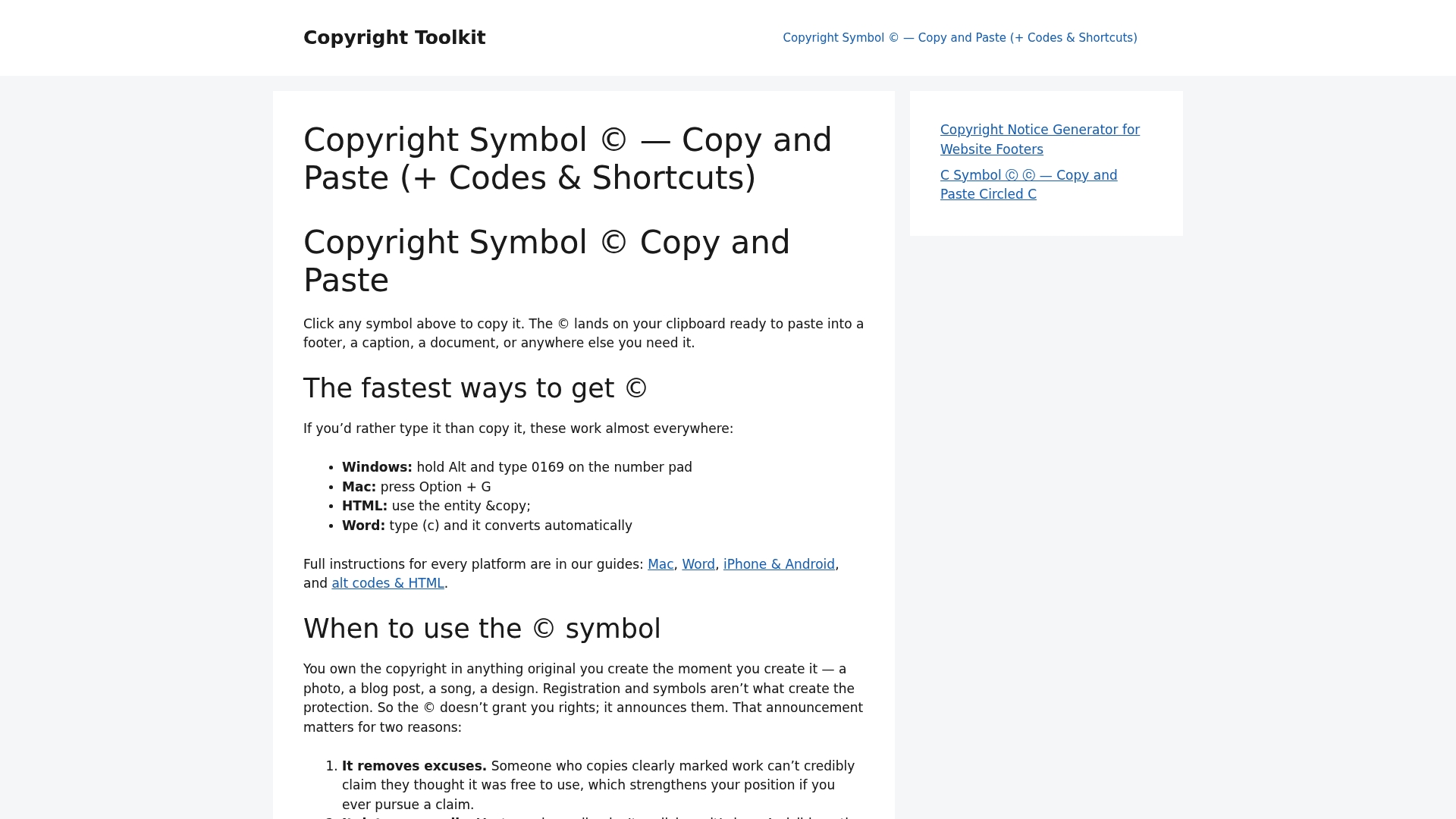
Copyrighttoolkit’s resources are built around preventing exactly that. Whether you need to copy the copyright symbol for a quick notice, understand the difference between copyright and patent protection, or work through how AI-generated content interacts with registration requirements, the tools and guides are at Copyrighttoolkit. Getting the basics right early is almost always cheaper than fixing a problem later.
This article is general information, not legal advice. Copyright law turns on specific facts, registration timing, and jurisdiction. Consult a licensed copyright attorney for guidance on your situation, and verify current statutory text at copyright.gov or uscode.house.gov.
This article is general information, not a substitute for advice from a qualified lawyer. Consult a qualified legal professional about your own circumstances before acting on anything here.
Sources
The statutory text and official guidance are the only reliable starting points for any copyright infringement analysis. Here’s where to go:
For case-specific advice, statutory interpretation, or any situation involving a demand letter or active investigation, consult a licensed copyright attorney. These sources give you the framework; counsel gives you the application to your facts.