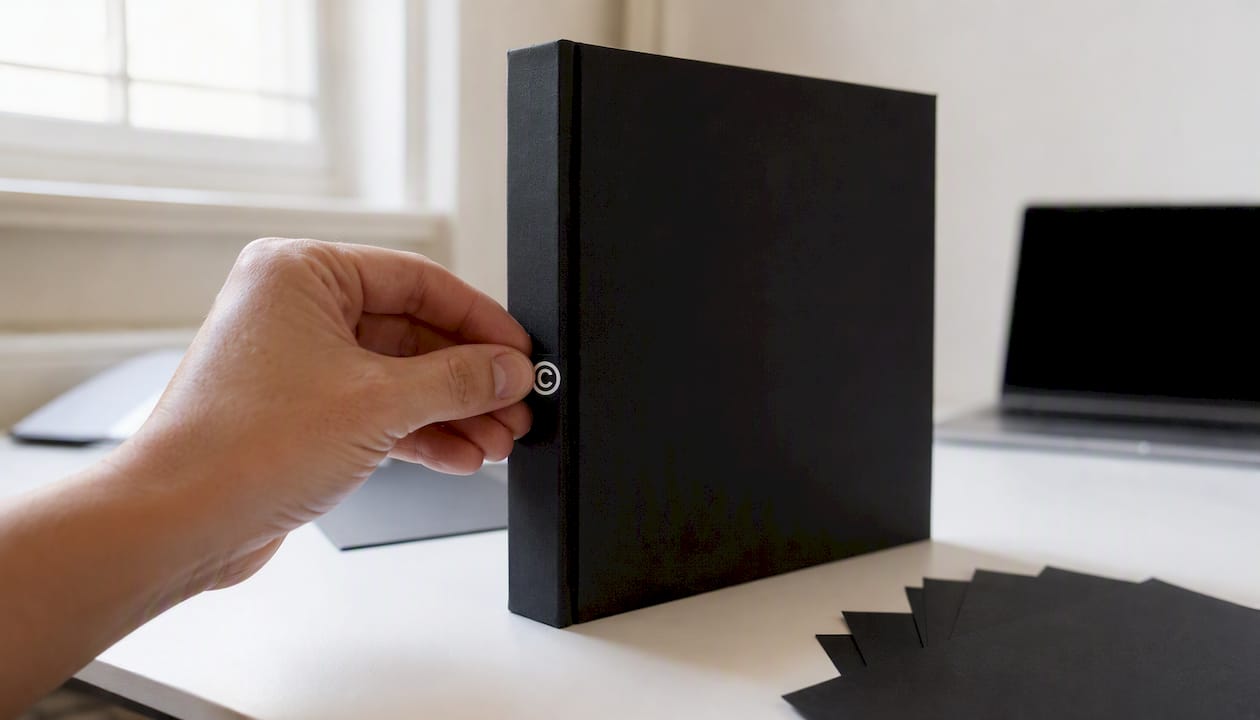
The © symbol means one thing plainly: the person or entity named in the notice claims copyright ownership over that creative work. Place it on your manuscript, website, or photograph and you are telling the world, and any court, that you consider this work yours.
A correct notice looks like this:
- © 2026 Jane Doe (for a single-year publication)
- © 2024–2026 Acme Studio (for a work with a range of publication years)
- Copyright 2026 Jane Doe (the word “Copyright” is a legally accepted substitute for the symbol)
The symbol does not register your copyright. It does not give you rights you would not otherwise have. Under U.S. law, copyright exists the moment a creative work is fixed in a tangible form, with or without the ©. What the notice does is put infringers on notice, which carries real legal weight when you end up in court. LegalZoom confirms that including the symbol is optional for works published after March 1, 1989, but still recommended because it strengthens your legal position and signals that permission is required.
Table of Contents
- What does the copyright symbol mean under U.S. law?
- How to write a correct copyright notice
- How does © differ from ™, ®, and ℗?
- Why federal registration matters even when you have ©
- Key Takeaways
- The part most creators get backwards
- Copyrighttoolkit makes marking your work immediate
- Useful sources and where to verify current rules
What does the copyright symbol mean under U.S. law?
Title 17 of the U.S. Copyright Act governs copyright notice in the United States. The statute sets out three required elements for a valid notice: the © symbol (or the word “Copyright” or the abbreviation “Copr.”), the year of first publication, and the name of the copyright owner. The notice must be affixed in a way that provides “reasonable notice” to an ordinary user, meaning it has to be findable, not buried.
Before March 1, 1989, omitting the notice from a published work could actually strip you of copyright protection entirely. The Berne Convention Implementation Act changed that. Works published on or after that date retain full copyright protection whether or not they carry a notice. Still, the practical stakes of omitting © remain significant.
Omitting a copyright notice can allow a defendant to claim “innocent infringement,” potentially reducing the damages a court awards. A proper notice removes or substantially weakens that defense. Under Title 17, a defendant who proves they were misled by the absence of notice may receive reduced statutory damages. Put the notice on the work and that argument disappears.
The U.S. Copyright Office Circular 3 reinforces this point and provides placement guidance for different work types. The Berne Convention, administered by WIPO, removed the international requirement for notice, but using © remains a globally recognized best practice.
Key legal effects of a proper copyright notice:
- Defeats the innocent infringement defense in damages calculations
- Identifies the owner publicly, making licensing inquiries straightforward
- Establishes the publication year on the face of the work
- Signals to search engines, platforms, and users that the work is protected
Pro Tip: The most common placement mistake is putting the notice only in a document’s metadata or hidden footer code. Courts apply a “reasonable notice” standard, which means an ordinary user must be able to find it without digging. On a website, a visible footer notice works. On a PDF, the notice should appear on the title or copyright page, not just in file properties.
How to write a correct copyright notice
The three-element formula from Title 17, Chapter 4 is straightforward, but creators consistently get the year wrong. The year in the notice must be the year of first publication of that version, not the year you created it. If you wrote a novel in 2023 and published it in 2025, the notice reads © 2025. For derivative works and compilations, use the compilation’s publication year, not the dates of the underlying material.
Circular 3 also covers the special rule for phonorecords: sound recordings use ℗ (the “P in a circle”) rather than ©. A music release typically carries both symbols, one for the underlying composition and one for the recording itself.
| Work type | Recommended notice form | Placement |
|---|---|---|
| Book or printed work | © 2026 Author Name | Title page verso (copyright page) |
| Photograph | © 2026 Photographer Name | Caption, border, or embedded EXIF metadata |
| Website | © 2026 Company Name | Visible footer on every page |
| Video | © 2026 Producer Name | Opening or closing credits |
| Sound recording | ℗ 2026 Record Label or Artist | Label, sleeve, or streaming metadata |
| Software | © 2026 Developer Name | About screen, splash screen, or source header |
Ready-to-copy templates:
- Book copyright page:
© 2026 [Your Name]. All rights reserved. - Website footer:
© 2026 [Company Name] - Photo caption:
© 2026 [Photographer Name] - Sound recording:
℗ 2026 [Rights Holder]
For a full formatted book copyright page with all required elements, Copyrighttoolkit has templates you can adapt directly.
How does © differ from ™, ®, and ℗?
These four symbols protect entirely different things. Mixing them up is not just a cosmetic error; it can weaken your actual legal position or mislead the public about rights you do not hold.
Per LegalClarity’s breakdown of symbol rules:
- © covers original creative expression: writing, photography, music, software, art. It does not protect names, titles, slogans, or brand identifiers.
- ™ indicates an unregistered trademark. Any business can use it on a brand name or logo to signal a claim, but it carries no federal registration behind it.
- ® means the mark is registered with the U.S. Patent and Trademark Office. Using ® on an unregistered mark is a federal violation. For a full guide on when and how to use it, see Copyrighttoolkit’s page on the registered trademark symbol.
- ℗ applies exclusively to sound recordings on phonorecords. It is the audio equivalent of ©.
A company logo often carries both © and ®: the © covers the original graphic design as a creative work, while the ® covers the mark’s function as a brand identifier. They are not redundant; they protect different legal interests in the same image.
One confusion worth flagging: © does not protect the title of a book, the name of a band, or a product name. Those are trademark territory. A creator who puts © next to their brand name thinking it protects the name is mistaken, and that mistake can matter if someone else registers the name as a trademark later.

Why federal registration matters even when you have ©
The © symbol and federal registration are not the same thing, and treating them as equivalent is one of the most expensive mistakes a creator can make. LegalClarity states this plainly: adding © to a work does not constitute federal registration. Registration is a separate filing with the U.S. Copyright Office, and it unlocks rights the symbol alone cannot provide.
What registration gives you that © alone does not:
- The right to sue for infringement in federal court (registration is a prerequisite)
- Eligibility for statutory damages (up to $150,000 per willful infringement) and attorney’s fees
- A public record of ownership that simplifies licensing and enforcement
- Prima facie evidence of validity if registered within five years of publication
Timing is the critical variable. Register before infringement occurs, or within three months of first publication, and you preserve access to statutory damages and attorney’s fees. Register after infringement begins and you are limited to actual damages, which are often difficult to prove and frequently lower than statutory awards.
Practical steps after marking a work:
- File with the U.S. Copyright Office at copyright.gov
- Keep dated records of creation: drafts, files with timestamps, emails
- Store a copy of the published work as evidence of the publication date
- Renew your notice practice for each new version or edition
Pro Tip: Many creators register only after discovering infringement. At that point, statutory damages are off the table if the infringement predates registration. File early, even for works you think are low-risk. The filing fee is modest and the protection gap is enormous.
Key Takeaways
The © symbol is a public claim of ownership that defeats the innocent infringement defense, but federal registration with the U.S. Copyright Office is the only step that unlocks statutory damages and the right to sue in federal court.
| Point | Details |
|---|---|
| Notice vs. registration | © signals ownership but does not register your copyright; registration is a separate U.S. Copyright Office filing. |
| Notice is optional post-1989 | Works published after March 1, 1989 retain copyright without ©, but omitting it risks an innocent infringement defense. |
| Correct notice format | Use © + year of first publication + owner name; sound recordings use ℗ instead of ©. |
| Register early | Filing before infringement or within three months of publication preserves statutory damages and attorney’s fees. |
| Copyrighttoolkit | Copyrighttoolkit provides ready-made notice templates and copy-paste symbol tools so you can mark and format works immediately. |
The part most creators get backwards
Most copyright advice focuses on the symbol itself, as if placing © on a work is the finish line. It is closer to the starting line.
The symbol is a public declaration. It costs nothing, takes seconds, and removes a defendant’s most convenient excuse in court. Skipping it is genuinely careless. But the creators who end up with real enforcement leverage are the ones who registered before anything went wrong, not the ones who scrambled to file after discovering their work on someone else’s website.
There is also a subtler problem: creators often use © as a substitute for thinking about what they actually own. A logo gets © when the brand name inside it needs ™ or ®. A website footer says © 2019 when the site has been updated every year since. A photographer embeds the notice in EXIF data and calls it done, not realizing a social media upload strips that metadata in seconds.
The best practice is not complicated. Before you publish anything, write the notice correctly, put it somewhere visible, and file the registration. After that, keep dated records of your drafts and source files. If a dispute ever arises, those timestamps are what a lawyer actually needs, not just the © on the cover.
One more thing worth saying plainly: the Berne Convention made notice optional internationally, but “optional” does not mean “irrelevant.” A work without a notice is not unprotected, but it is harder to enforce and easier to misuse. The symbol is a one-second investment with a potentially large return.
Copyrighttoolkit makes marking your work immediate
You now have the legal framework. The faster part is actually placing the symbol.
Copyrighttoolkit gives you every © character variant, keyboard shortcut, and HTML code in one place, so you are not hunting through character maps or copying from random web pages. The book copyright page templates are formatted to U.S. standards and ready to drop into your manuscript. The symbol copy-paste tool handles the character itself in seconds.
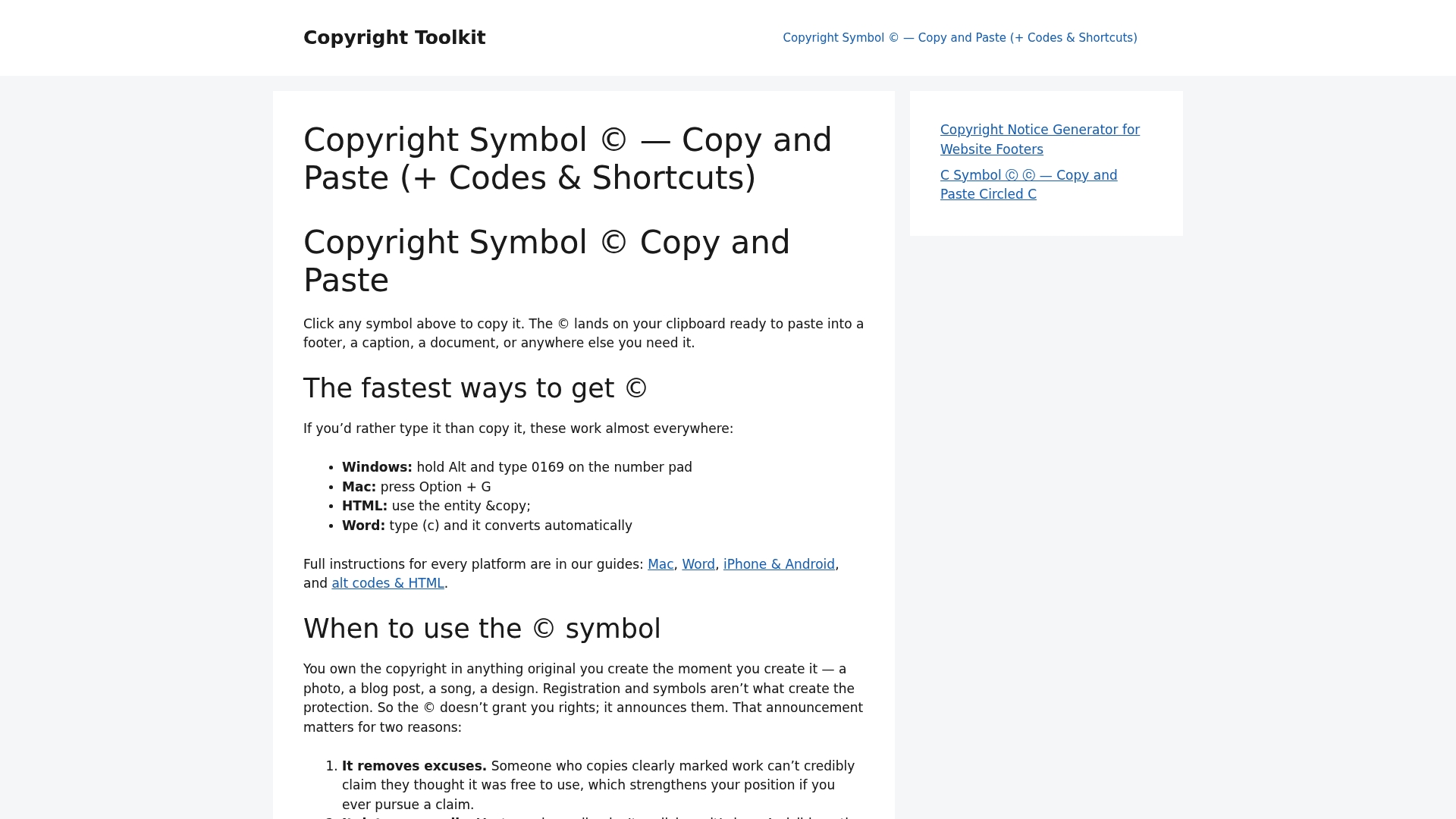
If you are also working with trademarks, the registered trademark symbol guide covers ® and ™ with the same depth. Head to Copyrighttoolkit to grab the symbol, copy a notice template, and mark your work correctly today.
Useful sources and where to verify current rules
The rules around copyright notice come from primary legal sources. When in doubt, go directly to the statute and the Copyright Office, not a summary.
Primary U.S. sources:
- Chapter 4 – Copyright Notice, Deposit, and Registration
- Circular 3 Copyright Notice
- Copyright © Symbol Rules: Use, Placement, and Penalties – LegalClarity
- Copyright Symbol: How to Use It and Legal Requirements – LegalClarity
- WIPO treaties (Berne Convention) – WIPO
- Copyright symbol – Wikipedia
- How Do I Use the Copyright Symbol? – LegalZoom
International context:
- WIPO Berne Convention treaty page: confirms notice is not required internationally under Berne but remains best practice
Explanatory resources used in this article:
| Source | What it covers |
|---|---|
| LegalClarity: © Symbol Rules | Placement rules, innocent infringement defense, symbol differences |
| LegalClarity: How to Use the © Symbol | Notice vs. registration distinction, legal requirements |
| LegalZoom: How Do I Use the Copyright Symbol? | Consumer-facing guidance, optional-but-recommended framing |
| Wikipedia: Copyright symbol | Unicode U+00A9, character history, related symbols |
This article provides general information about U.S. copyright law, not legal advice. Confirm current rules and fees with the U.S. Copyright Office at copyright.gov or consult a qualified intellectual property attorney.